
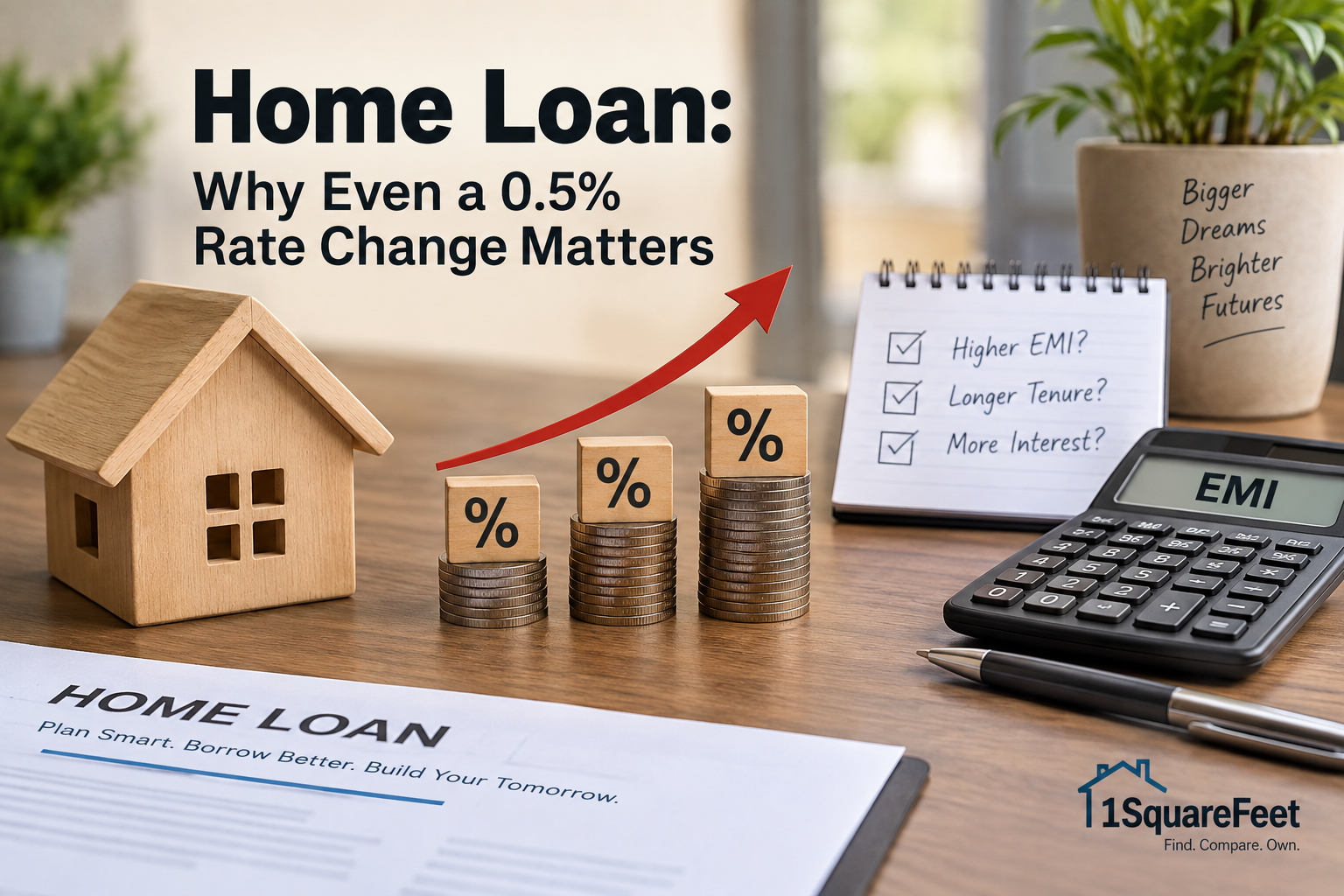
Home loan may look affordable when you calculate today’s EMI. But over a 15–20 year tenure, even a small change in the interest rate can significantly increase your total repayment.
Buying a home is one of the biggest financial decisions most people make. While buyers usually focus on the property price, down payment and current home loan EMI, one factor often receives less attention: the long-term impact of interest rate changes.
For a large loan such as ₹1 crore, even a 0.50% change in the interest rate can make a meaningful difference to your monthly cash flow and the total interest paid over the loan tenure.
Let’s understand the numbers.
₹1 Crore Home Loan at 8.5%: What Does It Cost?
Suppose you take a ₹1 crore home loan for 20 years at an interest rate of 8.5% per annum.
The approximate EMI would be: ₹86,782 per month
Over 20 years:
- Loan Principal: ₹1 crore
- Approximate EMI: ₹86,782
- Total repayment: Around ₹2.08 crore
- Total interest: Around ₹1.08 crore
In other words, a ₹1 crore loan can result in interest payments exceeding the original amount borrowed when the loan is retained for the full tenure.
This is why homebuyers should not look at the EMI alone. The interest rate and loan tenure together determine the actual cost of borrowing.
What Happens If the Rate Increases by Just 0.50%?
Consider the same ₹1 crore loan for 20 years.
| Interest Rate | Approx. EMI | Approx. Total Interest |
|---|---|---|
| 7.0% | ₹77,530 | ₹86 lakh |
| 8.0% | ₹83,644 | ₹1.01 crore |
| 8.5% | ₹86,782 | ₹1.08 crore |
| 9.0% | ₹89,973 | ₹1.16 crore |
| 9.5% | ₹93,213 | ₹1.24 crore |
These figures are indicative and actual repayment can vary depending on the lender, reset mechanism, loan structure and timing of rate changes. The calculation nevertheless demonstrates the sensitivity of a large loan to interest rates.
For example, moving from 8.5% to 9% increases the EMI by roughly ₹3,200 per month.
That means approximately: ₹38,000 additional outgo every year, assuming the loan structure keeps the higher EMI. Over a long period, the cumulative interest impact can run into several lakhs.
Why Floating-Rate Home Loans Need Regular Monitoring
Most homebuyers choose floating-rate loans because the initial rate may be attractive and the rate can move down when the underlying benchmark falls.
However, the opposite can also happen. When the benchmark-linked lending rate rises, the interest rate applicable to a floating-rate loan can increase according to the terms of the loan.
The RBI has specifically required lenders to communicate the impact of interest-rate resets on EMI/tenure for applicable floating-rate EMI-based personal loans and to provide information about repayment options when rates rise. (Reserve Bank of India)
For housing loans, RBI directions also require lenders to consider the borrower’s repayment capacity and provide adequate headroom for possible increases in EMI and/or extension of tenure. (Reserve Bank of India)
The important point for a borrower:
Don’t assume that your original EMI will remain unchanged for the next 15 or 20 years.
A floating-rate loan should be treated as a financial commitment that needs periodic review.
EMI Increase or Loan Tenure Increase?
When interest rates rise, there can be two broad ways the additional interest burden may be reflected:
1. Higher EMI
Your monthly payment increases while the tenure is maintained. This can affect monthly household cash flow but may help prevent the loan from extending substantially.
2. Longer Tenure
The EMI may remain relatively similar while the repayment period increases. This may appear comfortable from a monthly cash-flow perspective, but a longer repayment period can result in higher total interest outgo.
Therefore, borrowers should ask their lender:
- What happens to my EMI after a rate reset?
- Will the tenure increase?
- What is my revised outstanding principal?
- How many EMIs are remaining?
- What is the applicable benchmark?
- What is my spread over the benchmark?
- Can I make a partial prepayment?
The Real Home Loan Trap Is Not the ₹1 Crore Loan
The problem is not necessarily taking a ₹1 crore home loan. The bigger issue is taking a large loan without understanding its total financial cost.
A borrower may see: ₹86,782 EMI and conclude that the loan is affordable.
But the more important questions are:
- How much interest will I pay?
- What happens if the rate increases by 0.50%?
- Can my income comfortably support a higher EMI?
- What happens if my income temporarily falls?
- Can I make annual part-prepayments?
- What will my outstanding principal be after five years?
These questions can be more important than simply asking, “What is the lowest interest rate available today?”
How Homebuyers Can Reduce the Interest Burden
1. Don’t automatically choose the longest tenure
A 20-year or 25-year tenure reduces the initial EMI but can substantially increase total interest. If your income comfortably permits a higher EMI, a shorter tenure can reduce the overall interest burden.
2. Make partial prepayments
Even relatively small prepayments made during the early years of a loan can have a significant impact because the outstanding principal is higher during the initial part of the loan. Before making a prepayment, however, check the applicable loan terms and your own liquidity requirements.
3. Review your interest rate periodically
Don’t assume that the rate on your existing home loan is automatically competitive. Check your current rate against the rates applicable to comparable borrowers and discuss the possibility of a rate revision with your lender.
4. Consider a balance transfer carefully
A balance transfer may make financial sense where the difference between your existing rate and the available rate is meaningful and the remaining principal is substantial.
But don’t look only at the interest rate.
Also consider:
- Processing fees
- Legal/technical charges
- Administrative charges
- Documentation costs
- Remaining loan tenure
- Outstanding principal
- Savings in total interest
The correct comparison is total saving after all transfer costs, not simply the difference between two interest rates.
5. Maintain an EMI buffer
A home loan is a long-term liability. Before taking a large loan, calculate whether your household can handle an increase in EMI without disturbing essential expenses, investments and emergency savings.
Example: Why Early Prepayment Matters
Suppose a borrower has a ₹1 crore loan. Instead of waiting until the final years of the loan, the borrower makes periodic principal prepayments during the early years. The outstanding principal reduces faster.
As interest is calculated on the outstanding loan amount, reducing principal earlier can reduce the interest charged over the remaining tenure.
This is why loan repayment strategy matters almost as much as the initial interest rate.
What Should You Check Before Taking a ₹1 Crore Home Loan?
Before signing the loan agreement, ask the lender for a clear illustration covering:
- Loan amount: ₹1 crore
- Tenure: 15/20/25 years
- Current interest rate: ______
- Benchmark: ______
- Spread: ______
- Current EMI: ______
- Total interest at current rate: ______
- Reset frequency: ______
- Prepayment terms: ______
Then run the same calculation at: Current rate + 0.50% and Current rate + 1.00%
This simple exercise can tell you whether your finances have enough room to absorb future rate movements.
Home Loan and Property Buying Should Be Planned Together
At 1SquareFeet, we believe property buying should not be looked at only from the perspective of finding a house. The buyer should evaluate the complete financial picture:
Property Price + Down Payment + Home Loan + EMI + Interest Cost + Registration Costs + Maintenance + Future Financial Capacity
A property that looks affordable based only on today’s EMI may become financially uncomfortable if the buyer has little room for future rate changes. Similarly, a slightly more expensive property may sometimes be manageable if the buyer has a stronger down payment, suitable tenure and adequate income buffer. The right approach is to evaluate the property and financing together.
Final Takeaway
A ₹1 crore home loan is a major long-term financial commitment.
A difference of 0.50% in interest rate may look insignificant, but on a large loan and long tenure, it can translate into thousands of rupees of additional monthly EMI and several lakhs of additional interest. Therefore, before taking a home loan:
Don’t just ask, “What is my EMI?”
Ask:
“What will this home loan actually cost me over its entire life?”
Understand the benchmark, reset mechanism, EMI/tenure impact, prepayment options and total interest before signing the loan agreement.
A well-planned home loan can help you purchase your dream property without putting unnecessary pressure on your future finances.
Disclaimer: EMI and interest calculations in this article are illustrative only. Actual home-loan rates, EMIs, tenure, benchmark resets, charges and eligibility depend on the lender, borrower profile, loan agreement and prevailing market conditions. Buyers should verify the applicable terms directly with the lender and take appropriate financial advice before making a borrowing decision.


Join The Discussion