
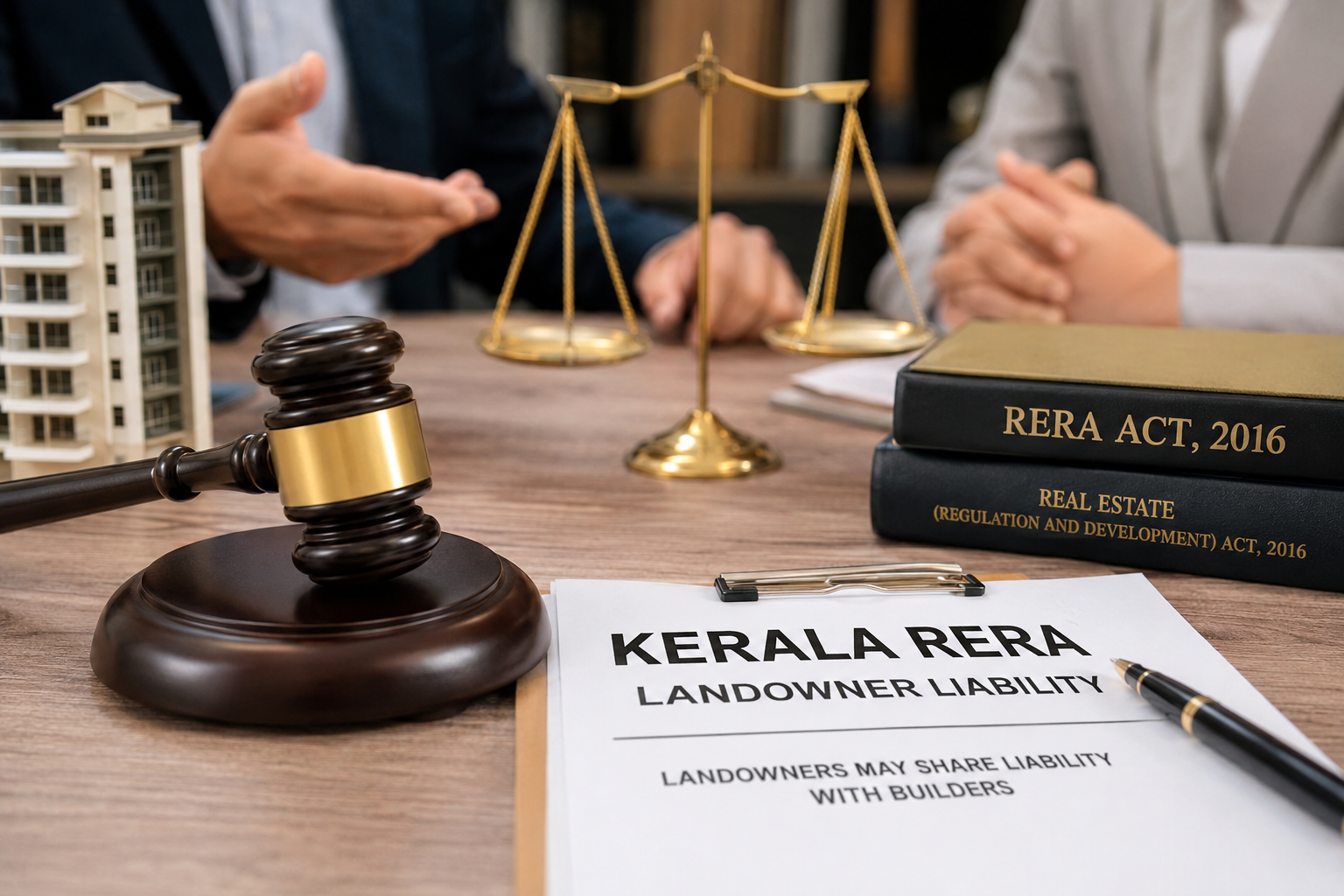
Kerala RERA Clarifies When Landowners Can Be Held Responsible Alongside Builders
Kerala RERA Landowner Liability has become a major topic of discussion in India’s real estate sector following a landmark ruling by the Kerala Real Estate Regulatory Authority (K-RERA). The decision clarifies that landowners who actively participate in the financial or commercial aspects of a real estate project may also share legal responsibility with builders under certain circumstances. The ruling has important implications for homebuyers, developers, landowners, and investors involved in joint development projects.
The decision is particularly relevant for projects developed under Joint Development Agreements (JDAs), where landowners contribute land while developers undertake construction and sales. It reinforces the principle that accountability may extend beyond the builder when a landowner has a substantive role in the project.
Key Highlights
| Particular | Details |
|---|---|
| Authority | Kerala Real Estate Regulatory Authority (K-RERA) |
| Key Issue | Liability of landowners in joint development projects |
| Major Finding | Active landowners may be treated as joint promoters |
| Beneficiaries | Homebuyers and apartment allottees |
| Impact | Greater accountability in real estate projects |
What Is the Kerala RERA Ruling?
According to recent reports, K-RERA held that where a landowner actively participates in project finances, revenue sharing, or profit-sharing, the landowner cannot simply distance themselves from obligations owed to homebuyers. In such circumstances, the landowner may be treated as a joint promoter and share responsibility with the developer.
This approach focuses on the actual role played by the landowner, rather than land ownership alone.
Understanding Joint Development Projects
In many Indian cities, especially where land values are high, landowners enter into Joint Development Agreements (JDAs) with developers.
Typically:
- Landowner contributes land.
- Builder undertakes construction.
- Apartments or revenue are shared.
- Profits are divided according to the agreement.
These arrangements are common in:
- Kochi
- Bengaluru
- Hyderabad
- Mumbai
- Pune
- Chennai
- Ahmedabad
- Delhi NCR
Why This Ruling Matters
For years, many homebuyers pursued legal action only against developers when projects were delayed or obligations remained unfulfilled.
However, if the landowner was actively involved in the commercial aspects of the project, questions often arose about whether they should also bear responsibility.
The reported K-RERA ruling strengthens the principle that responsibility may follow the actual role and level of participation in the project, not merely the title of “builder.”
Impact on Homebuyers
The decision could improve consumer protection by:
- Expanding accountability where appropriate.
- Increasing confidence in joint development projects.
- Encouraging better governance.
- Discouraging attempts to avoid liability through contractual structuring.
Impact on Landowners
Landowners entering into development agreements should now carefully evaluate:
- Their financial participation.
- Profit-sharing arrangements.
- Marketing responsibilities.
- Execution of sale deeds.
- Contractual obligations.
Professional legal advice before signing a JDA is increasingly important.
Impact on Builders
Developers may need to:
- Clearly define responsibilities.
- Improve compliance documentation.
- Ensure transparent agreements.
- Coordinate more closely with landowners.
This can reduce future disputes and improve project governance.
Legal Perspective Under RERA
The definition of “promoter” under the Real Estate (Regulation and Development) Act, 2016 has been the subject of judicial interpretation. Earlier court decisions have indicated that a landowner is not automatically a promoter merely because they own the land. Instead, the extent of involvement, contractual role, and statutory provisions determine liability.
The recent K-RERA ruling highlights that where landowners actively participate in the project’s financial or commercial framework, they may also be treated as joint promoters in the circumstances of the case.
Due Diligence Checklist for Property Buyers
Before purchasing a flat in a joint development project, verify:
- RERA registration.
- Identity of the registered promoter(s).
- Development Agreement.
- Land ownership records.
- Encumbrance Certificate.
- Approved building plans.
- Occupancy Certificate (where applicable).
- Project approvals.
- Litigation history.
- Financial status of the project.
Why Legal Due Diligence Is More Important Than Ever
A buyer should never rely solely on marketing brochures or verbal assurances.
Professional due diligence should include:
- Title verification.
- Approval verification.
- RERA registration status.
- Society approvals.
- Mortgage verification.
- Court case searches.
- Compliance with local development regulations.
Expert Opinion
The reported K-RERA decision reflects a broader trend toward strengthening consumer protection in India’s real estate sector. While each dispute depends on its facts and contractual arrangements, the ruling underscores that participants who play a substantive role in a project’s commercial structure may also bear corresponding responsibilities. It is also important to distinguish this context from earlier judicial decisions that emphasized that mere land ownership does not automatically make someone a promoter for all RERA purposes.
What Investors Should Learn
Investors should assess:
- Structure of the JDA.
- Roles of landowner and developer.
- RERA disclosures.
- Financial strength of the developer.
- Litigation history.
- Compliance track record.
Projects with transparent governance are generally better positioned to inspire buyer confidence.
Frequently Asked Questions
Can a landowner be liable under RERA?
A landowner may be liable in certain situations depending on their contractual role, statutory obligations, and level of involvement in the project. Mere ownership of land does not automatically make every landowner liable for all promoter obligations.
What did Kerala RERA clarify?
The reported ruling indicates that landowners who actively participate in project finances or profit-sharing may be treated as joint promoters in the circumstances of the case.
Does this apply across India?
The ruling applies to the matter before K-RERA. Similar issues in other states will depend on applicable law, contractual arrangements, and decisions of the relevant authorities or courts.
What is a Joint Development Agreement?
A Joint Development Agreement is an arrangement in which a landowner provides land and a developer undertakes construction, with revenue or developed units typically shared according to agreed terms.
Why should buyers verify the development agreement?
It helps buyers understand who is responsible for different aspects of the project and whether multiple parties may have obligations toward allottees.
Key Takeaways
- K-RERA has emphasized accountability in joint development projects where landowners play an active commercial role.
- The ruling strengthens consumer protection for homebuyers.
- Developers and landowners should draft JDAs with clearly defined responsibilities.
- Buyers should conduct comprehensive legal and technical due diligence before purchasing property.
- Transparency, compliance, and clearly documented roles remain essential for reducing disputes in the real estate sector
Conclusion
The Kerala RERA Landowner Liability ruling is an important development for India’s real estate sector. It highlights that responsibility in certain joint development projects may extend beyond the builder, depending on the landowner’s role and contractual obligations. Homebuyers should continue to perform thorough legal due diligence, while developers and landowners should ensure transparent agreements and full compliance with applicable laws.
Join The Discussion